From Greek original to digital restoration
Εὐρώπη
The name in its original Greek form. The breathing marks, accents, and length symbols mark the true classical pronunciation. This is the name the ancients spoke.
Europa
Stripped of its Greek identity, reduced to Latin letters. The breathing, the accent, the scholarly precision — all erased by the constraints of ASCII.
Eurṓpē
The full scholarly orthography with stress and length marks restored. This is not decoration — it is philological accuracy. The domain encodes to Punycode, but the browser displays the truth.
Eurṓpē.com → xn--eurp-eva0406b.com
The non-ASCII characters are encoded while the ASCII remains visible. To the DNS, it is Punycode. To humanity, it is Eurṓpē.
How the name was truly spoken in antiquity
Classical Greek: eu-RO-pee (acute on omega, long eta)
Europe, the West, the Broad Lands
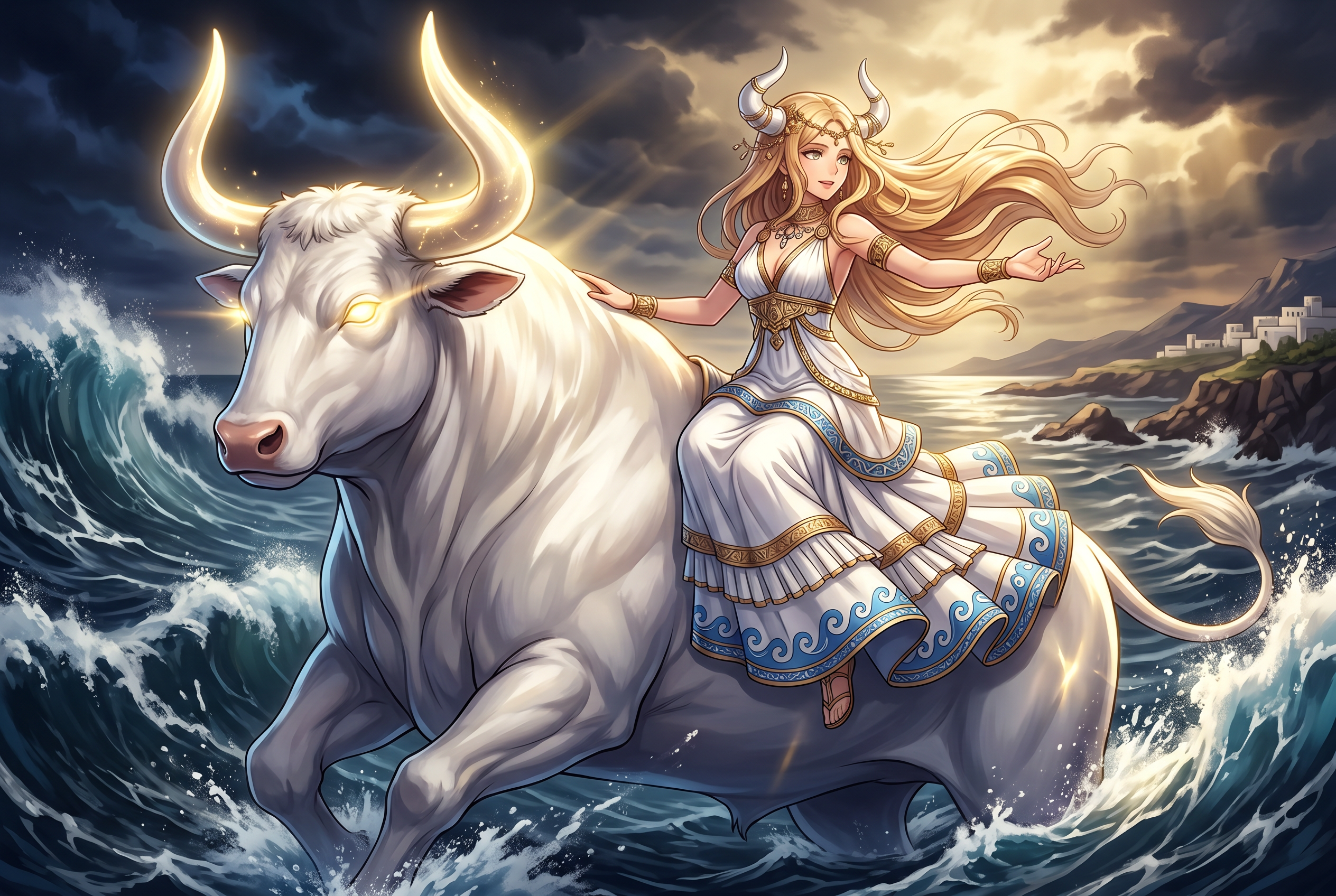
From Greek Εὐρώπη (Eurṓpē), traditionally interpreted as "broad-faced" or "wide-gazing" from εὐρύς (eurýs, "wide") + ὤψ (ṓps, "face, eye"). The name originally belonged to the Phoenician princess abducted by Zeus in the form of a white bull, before becoming the designation for the continent.
The cradle of Greek civilization — a sea dotted with islands that were the stepping stones between Europe and Asia.
The misty lands beyond the Alps — forests and rivers that the Greeks knew only through rumor and trade.
The southern tip of Europe, where the mountains meet the sea. Here the polis was born, and here the Greek gods found their home.
The western edge of the world — where the Mediterranean meets the Atlantic. Beyond lay the unknown Ocean.
Stories of the personified continent
Zeus saw the Phoenician princess gathering flowers by the sea. He transformed into a white bull of unearthly beauty. When she climbed upon his back, he plunged into the waves and carried her to Crete.
On Crete, Eurṓpē bore three sons to Zeus: Minos, who became the great lawgiver; Rhadamanthus, who judged the dead; and Sarpedon, who ruled Lycia and fought at Troy.
Herodotus divided the world into three: Libyē to the south, Asíā to the east, and Eurṓpē to the northwest. He wondered at their boundaries — the Nile, the Phasis, the Hellespont — and whether any man could truly say where one ended and another began.
Divinities associated with this realm
Attested forms and scholarly conventions
See how Eurṓpē is encoded character by character. Explore the Greek orthography, the Punycode transformation, and the Unicode composition.
europe
Eurṓpē